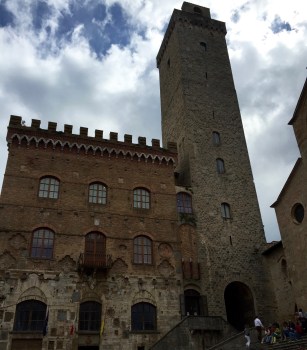


I have to admit I didn’t really have any expectations San Gimignano but, wow, steeped in history and beautiful old architecture, it was far beyond what one could hope from a small, historical town in Tuscany. The tidbits of trivia I did know were that the city was the birthplace of poet Folgore da San Gimignano and it was the setting for the novel Where Angels Fear to Tread.
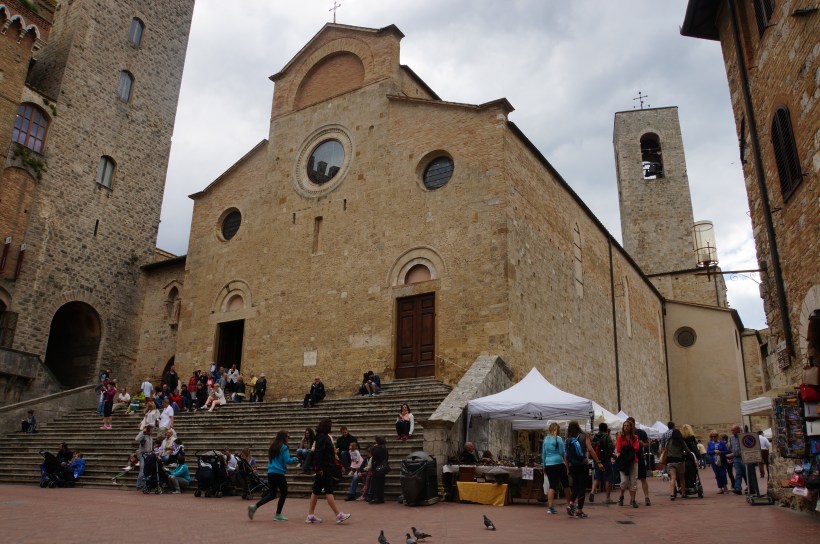
Known as the Town of Fine Towers, it is best described as a small medieval hill town, surrounded by three walls. In fact there are eight unique entrances that date back to the 12 and 13th centuries and a dismantled fortress from the 16th century, which sits in ruins. By the time we arrived the weather was not as ‘on our side’ as we had hoped so it was really a race against the clouds to get everything in and learn as much as we could before the downpours. I know, me, Italy and rain, right, Bea K Travels!
According to UNESCO, “the perimeter of the property is defined by two concentric rings of defensive walls. The inner ring was constructed in the late 10th century and in the 13th century it was reinforced with the construction of the outer wall. Inside, the medieval town contains all the elements that contribute to its Outstanding Universal Value: towers and tower houses, noble palaces rich in stone and terracotta decorations, late Roman churches, as well as the urban pattern of streets. Moreover, the urban fabric perfectly combines with a precious system of orchards set along secondary streets and building-free zones, which complement the late medieval urban layout. The unique skyline of the town, loftily perched in a dominant position, can be enjoyed from the main visual cones. Despite social transformation due to development over the last 60 years, the historical centre still retains the same ancient traditions, based on lively social dynamics.” (Source: http://whc.unesco.org/en/list/550)
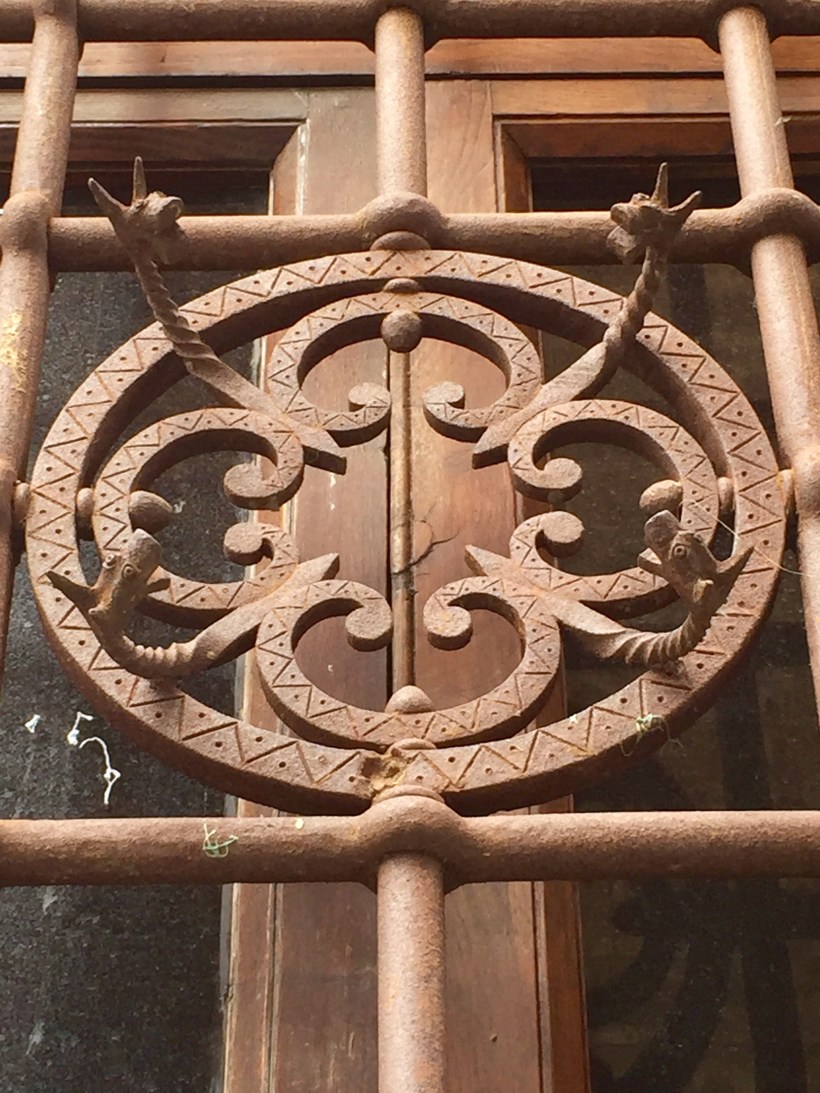
The ironwork and horse hitches that dominated Siena continued in this little city. This was a design found on a balcony railing near the centre of the Piazza della Cisterna
According to our friends at wikipedia “San Gimignano is famous for its medieval architecture, unique in the preservation of about a dozen of its tower houses, which, with its hilltop setting and encircling walls form “an unforgettable skyline”. The Romanesque secular and domestic architecture which may be distinguished from each other by their round and pointed arches, respectively. A particular feature which is typical of the region of Siena is that the arches of openings are depressed, with doorways often having a second low arch set beneath a semi-circular or pointed arch. Both Romanesque and Gothic windows sometimes have a bifurcate form, with two openings divided by a stone mullion under a single arch. Within the walls, the well-preserved buildings include notable examples of both Romanesque and Gothic architecture, with outstanding examples of secular buildings as well as churches. The Palazzo Comunale, the Collegiate Church and Church of Sant’ Agostino contain frescos, including cycles dating from the 14th and 15th centuries. The town also is known for the white wine, Vernaccia di San Gimignano, produced from the ancient variety of Vernaccia grape which is grown on the sandstone hillsides of the area.”


Wikipedia also explains that “at the heart of the town are four squares: the Piazza Duomo, on which stands the Collegiate Church; the Piazza della Cisterna, the Piazza Pecori and the Piazza delle Erbe and 14 preserved towers. To the north of the town is another significant square, Piazza Agostino, on which stands the Church of Sant’ Agostino. The locations of the Collegiate Church and Sant’ Agostino’s and their piazzas effectively divide the town into two regions. These churches house many significant pieces of 14th- and 15th-century renaissance art and impressive frescos everywhere.”


Piazza della Cisterna
“This Piazza is the main square of the town. It is triangular in shape and is surrounded by medieval houses of different dates, among them some fine examples of Romanesque and Gothic palazzos. At the centre of the piazza stands a well which was the main source of water for the town’s residents. The structure dates from 1346.Although much of it has been renewed in the late 20th century, parts of the paving date from the 13th century.” (Source: wikipedia)


Piazza Duomo
“This piazza is to the north of Piazza della Cistern and is connected by a passage adjacent to an open loggia. To the west, at the top of the square, stands the Collegiate Church, reached by a broad flight of steps. The name of the square would seem to imply that this church was at one time a cathedral, but although it was perhaps planned, this was not the case. Other important buildings on the square include the Palazzo Comunale and the Palazzo Podesta, the house of the mayor. The Palazzo Podesta is distinguished by its huge arched loggia.”
Like many of the smaller, Italian areas we visited, tourism and a desire to modernize continue to make these areas special and important to protect. While Maps could speak to the geology in a much more informed way than I, our guide also explained to us that the town is prone to landslides and is at risk for seismic activity in this area.
While I don’t think one could spend an entire day here, walking into the city centre is like stepping back in time to the Middle Ages – well, minus all the tourists with their backpacks & selfie sticks – you could see how the aristocratic would have lived in those imposing towers and what a vantage point they had over everything.


But, our day wasn’t done yet – we still had two more stops before our tour of the Tuscan region was complete. Next up, we stop at Castello di Monteriggioni, which was part of the Via Francine, taking you through from medieval to renaissance times. In the stretch between San Gimignano and Siena, the Via Francigena crossed the territory of Monteriggioni where one of the ancient pilgrim stopping places still survives, the abbey at Abbadia Isola.
Stay with us…
 Maps & Flip Flops