I have a colleague who has travelled quite extensively in Italy, with his wife and two kids, but also “with the boys” on cycling expeditions through the Italian countryside. Naturally, I hit him up for some advice before we left. “Hire a driver, and tour Tuscany for the day – it’s spendy, but you won’t regret it,” he said.
Well, mid-trip – and not feeling at all like we haven’t already spent an obscene amount of money – we noodled his advice with our extra days in Florence. Remembering Maps & FlipFlops EuroTrip Rule #1 – “Money is not the reason we’ll skip something, ” we went down to see Astrid’s Dutch bestie at the front desk of our fancy hotel in Florence, hired us a car & driver and hit the road two days later.
The fellow who drove us was a local and as he drove us out of Florence and towards Siena he explained that in Italy you actually have to go to school and become certified to become a tour guide. You can’t just memorize Lonely Planet, grab an umbrella and start herding people onto a bus. The idea being that Italy has rich and complex history, they don’t want some fly-by-night making it up as they go. Our guide explained this – showing us his credentials (often checked by the Italian police) – as we arrived at a church and he explained his training did not allow for him to go in with us, risk being fined for ‘touring’ us through something he was not certified in. I can’t begin to describe how expansive his knowledge was, how rapidly he rattled off the history and most importantly what a terrifying -yet oddly safe – driver he was!
Our tour was to take us through a section of Tuscany – specifically Siena, San Gimignano and through a vineyard for a little wine tasting. (each will be covered in individual posts). While there were tours that let you spend an entire day JUST drinking wine, we agreed time (and geography covered) was best spent with the three-stop tour, though I did feel like more wine & less churches would have been ok too.
According to wikipedia – “the historic centre of Siena has been declared by UNESCO a World Heritage Site. It is one of the nation’s most visited tourist attractions, with over 163,000 international arrivals in 2008. Siena is famous for its cuisine, art, museums, medieval cityscape and the Palio, a horse race held twice a year. Siena is located in the central part of Tuscany, in the middle of a vast hilly landscape between the Arbia river valley, the Merse valley, the Elsa valley, the Chianti hills, the Montagnola Senese and the Crete Senesi. The city has a long and storied history, dating back as far as 900-400 bc which you can read more on here.
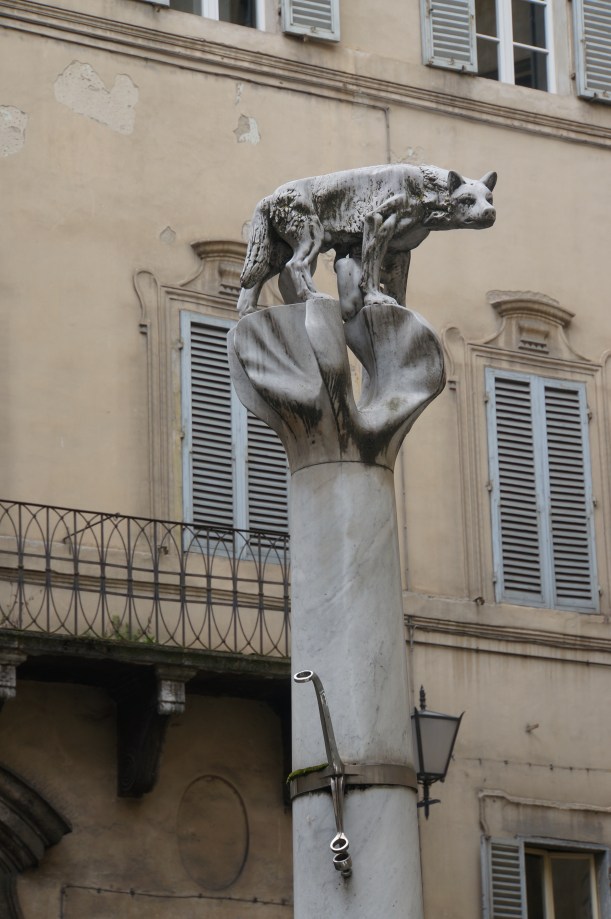
Wikipedia, in part details the local legend that “Siena was founded by Senius and Aschius, two sons of Remus and thus nephews of Romulus, after whom Rome was named. Supposedly after their father’s murder by Romulus, they fled Rome, taking with them the statue of the she-wolf suckling the infants (Capitoline Wolf), thus appropriating that symbol for the town.”
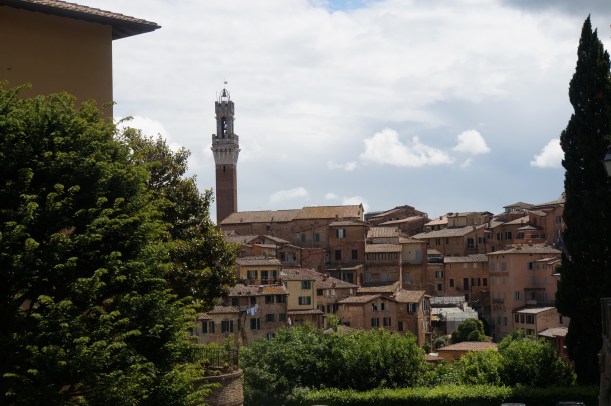
UNESCO describes Siena as the embodiment of a medieval city. “Its inhabitants pursued their rivalry with Florence right into the area of urban planning. Throughout the centuries, they preserved their city’s Gothic appearance, acquired between the 12th and 15th centuries. During this period the work of Duccio, the Lorenzetti brothers and Simone Martini was to influence the course of Italian and, more broadly, European art. The whole city of Siena, built around the Piazza del Campo, was devised as a work of art that blends into the surrounding landscape.”


Agriculture constitutes Siena’s primary industry. (Clearly, fertilizer is sexy!) And as of 2009, over 900 companies comprised a workforce with a total area of over 10 square kiometres (4 square miles) of useable agricultural area.
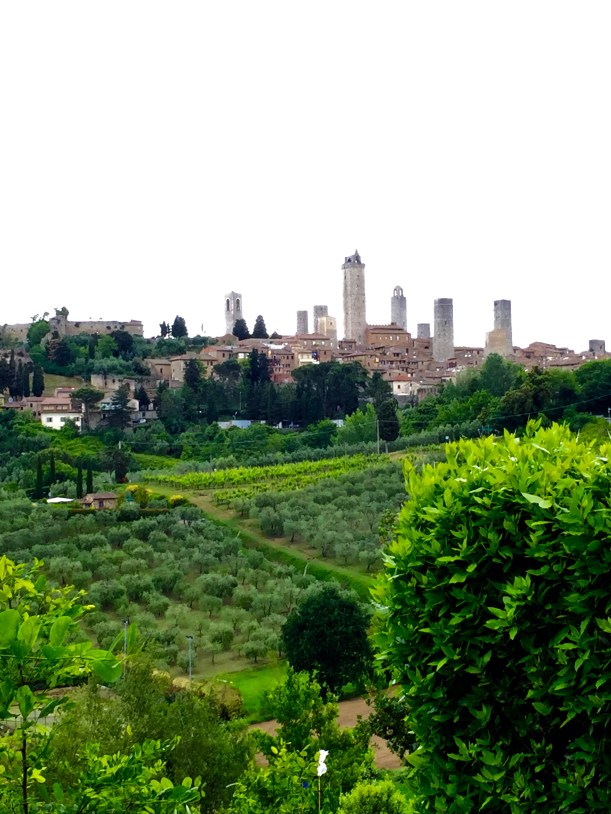
There are four main sights of Siena that our guide walked us through before dropping us at what was the best gelato shop we encountered in Italy:
The Siena Cathedral/Duomo: best described as designed in Romanesque-Gothic architecture. Believe it was built in the 12th century, with the main face of the church finished in 1380. The history books say that it was originally planned to be a basilica – perhaps to be the largest in the word – however ‘best-laid plans, as they say’ and for a number of reasons the plan was scaled back to its current architectural state. (source: wikipedia)
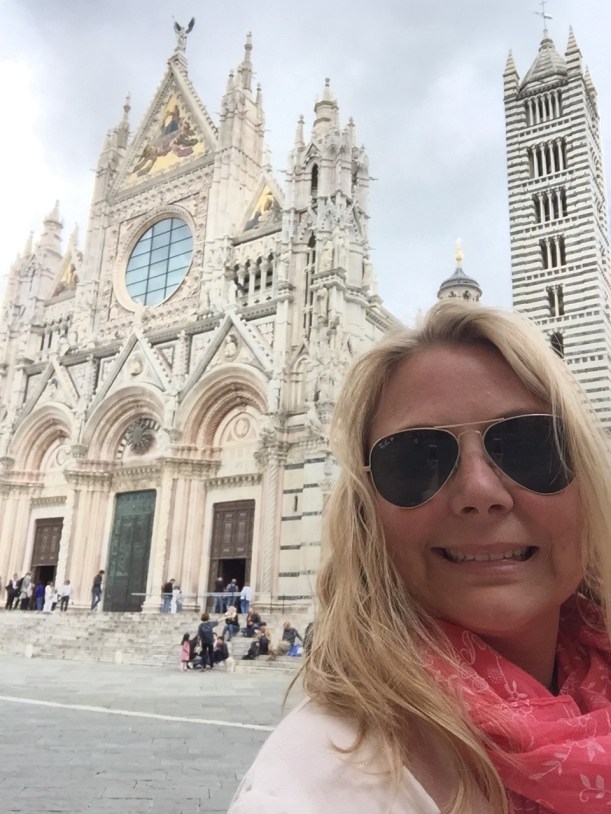
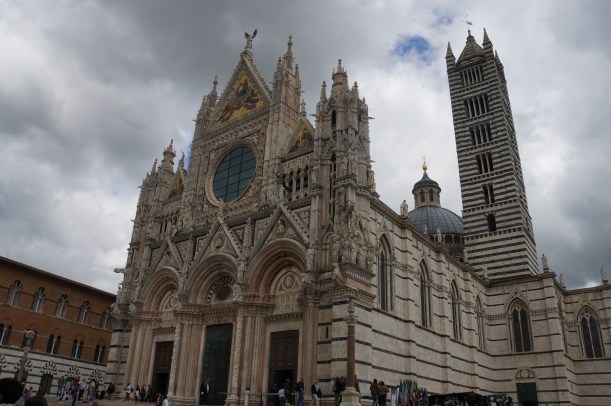
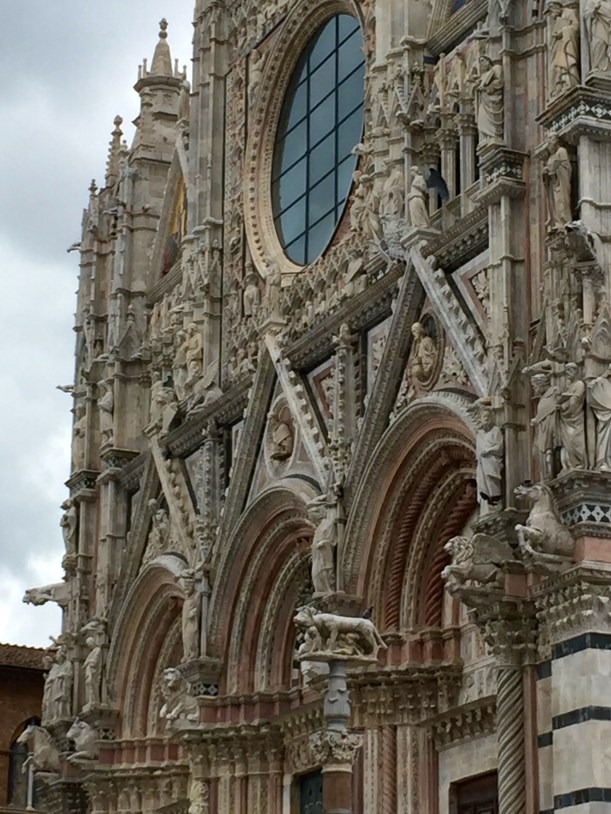
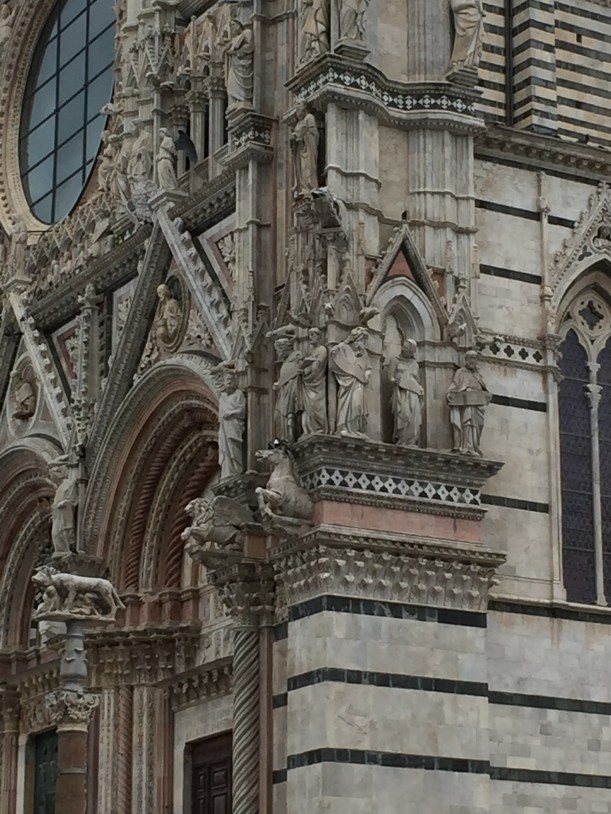
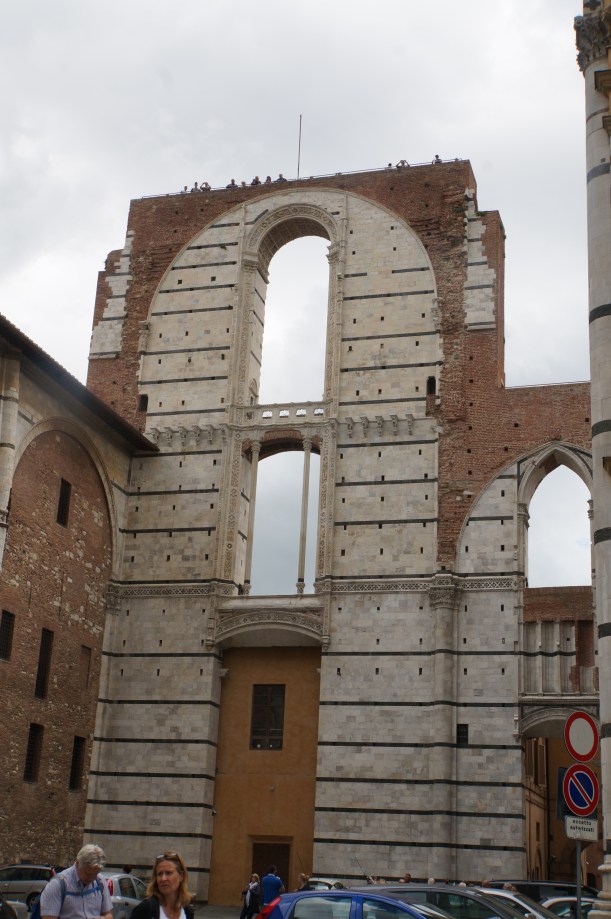
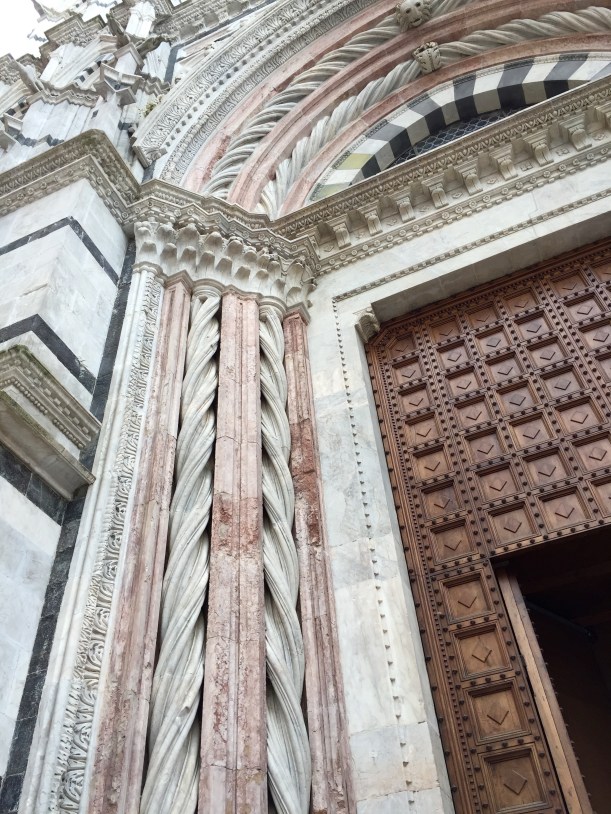
The Siena Cathedral Pulpit: is an octagonal 13th-century masterpiece sculpted by Nicola Pisano with lion pedestals and biblical bas-relief panels. The inlaid marble mosaic floor of the cathedral, designed and laboured on by many artists, is among the most elaborate in Italy. The Sacristy and Piccolomini library have well preserved Renaissance frescos by Ghirlandaio and Pinturicchio respectively. Other sculptors active in the church and in the subterranean baptistry are Donatello, Lorenzo Ghiberti, Jacopo della Quercia and others. The Museo dell’Opera del Duomo contains Duccio’s famous Maestà (1308–1311) and various other works by Sienese masters. More Sienese paintings are to be found in the Pinacoteca, e.g. 13th-century works by Dietisalvi di Speme. (Source: wikipedia)
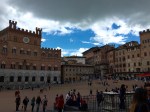
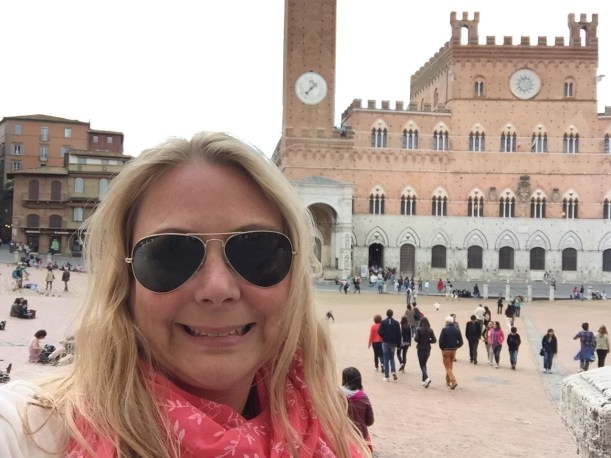
The Piazza del Campo: was, for me, the highlight of the town’s architectural history. Wikipedia describes it best as a “shell-shaped town square, unfurls before the Palazzo Pubblico with its tall Torre del Mangia. The square is well known as a section of the Palio horse race. The Palazzo Pubblico, is an art museum housing works such as Ambrogio Lorenzetti‘s frescoes depicting the Allegory and Effects of Good and Bad Government and also some of the finest frescoes of Simone Martini and Pietro Lorenzetti. (Source: wikipedia)
The Plazzo Salimbeni: is the original headquarters and current home of the Monte dei Paschi di Siena, one of the oldest banks in continuous existence in Europe. (Source: wikipedia)
But, back to the horses. Now in Calgary we have something called the Calgary Stampede – a western event that takes over the city for 10 (some say 11 – Sugar Shack, anyone?) days in early July. So, fair to say we know a little bit about horse racing – of the Chuck Wagon variety. But, our expertise in medieval horse racing is understandably limited. The Palio di Siena is run twice a year in early July and mid August. They run around the Piazza del Campo. Wikipedia tells me – and I’m sure our guide did on our tour when I may have tuned out- that “Seventeen Contrade (which are city neighbourhoods originally formed as battalions for the city’s defence) vie for the trophy: a painted banner, or Palio bearing an image of the Blessed Virgin Mary. For each race a new Palio is commissioned by well-known artists and Palios won over many years can often be seen in the local Contrade museum. During each Palio period, the city is decked out in lamps and flags bearing the Contrade colours. Ten of the seventeen Contrade run in each Palio: seven run by right (having not run in the previous year’s corresponding Palio) together with three drawn by lot from the remaining ten.”
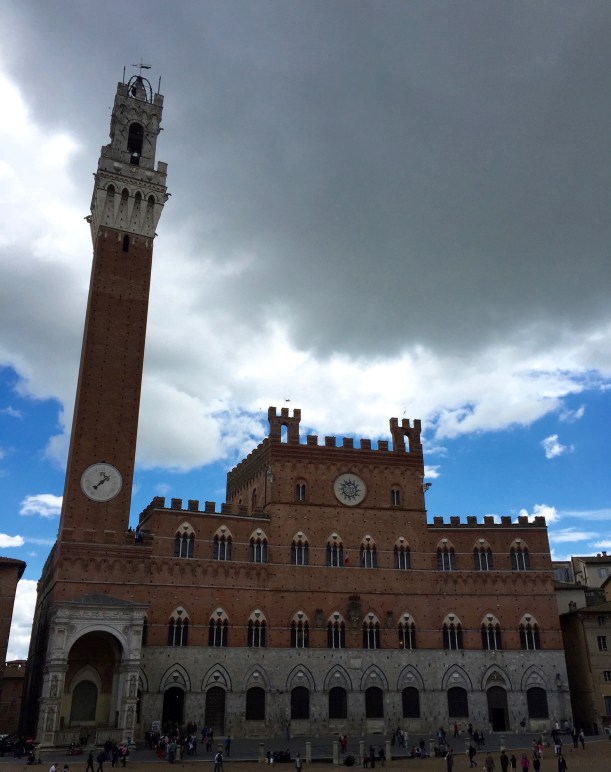
“A horse is assigned to each by lot and is then guarded and cared for in the Contrade stable. The jockeys are paid huge sums and indeed there are often deals and bribes between jockeys or between “allied” Contrade committees to hinder other riders, especially those of ‘enemy’ Contrade. For the three days preceding the Palio itself, there are practice races. The horses are led from their stables through the city streets to the Campo, accompanied by crowds wearing Contrade scarves or tee-shirts and the air is filled with much singing and shouting. Though often a brutal and dangerous competition for horse and bare-back rider alike, the city thrives on the pride this competition brings. (source: wikipedia)
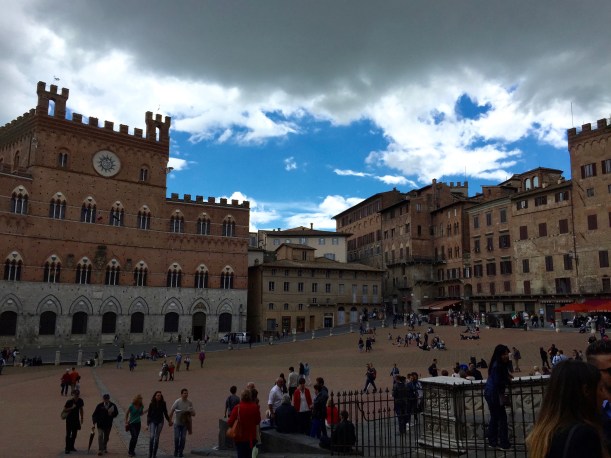
Wikipedia tells us that “the Palio is not simply a tourist event as a true Sienese regards this in an almost tribal way, with passions and rivalry similar to that found at a football ‘Derby’ match. In fact the Sienese are baptised twice, once in church and a second time in their own Contrade fountain. This loyalty is maintained through a Contrade ‘social club’ and regular events and charitable works. Indeed, the night before the Palio the city is a mass of closed roads as each Contrade organises its own outdoor banquet, often for numbers in excess of 1,000 diners. On the day of the Palio itself the horses are accompanied by a spectacular display of drummers and flag twirlers dressed in traditional medieval costumes who first lead the horse and jockey to the Contrade parish church and then join a procession around thePiazza del Campo square. This traditional parade is called the Corteo Storico, which begins in the streets and concludes in the Piazza del Campo encircling the square. There are often long delays while the race marshall attempts to line up the horses, but once underway the Campo becomes a cauldron of wild emotion for the 3 minutes of the race.”

Not unlike the Calgary Stampede, the event is not without its critics and much care is taken to ensure the safety and health of the horses who race. And, there are those who not supportive of it at all – believing the horses would be better served not to be raced in this fashion.
Siena is also well-known for its art. And wikipedia tells me that “over the centuries, Siena has had a rich tradition of arts and artists. The list of artists from the Sienese School include Duccio and his student Simone Martini, Pietro Lorenzetti and Martino di Bartolomeo. A number of well known works of Renaissance and High Renaissance art still remain in galleries or churches in Siena.”

“The Church of San Domenico contains art by Guido da Siena, dating to mid-13th century. Duccio’s Maestà which was commissioned by the City of Siena in 1308 was instrumental in leading Italian painting away from the hieratic representations of Byzantine art and directing it towards more direct presentations of reality. And his Madonna and Child with Saints polyptych, painted between 1311 and 1318 remains at the city’s Pinacoteca Nazionale.” (source: wikipedia)


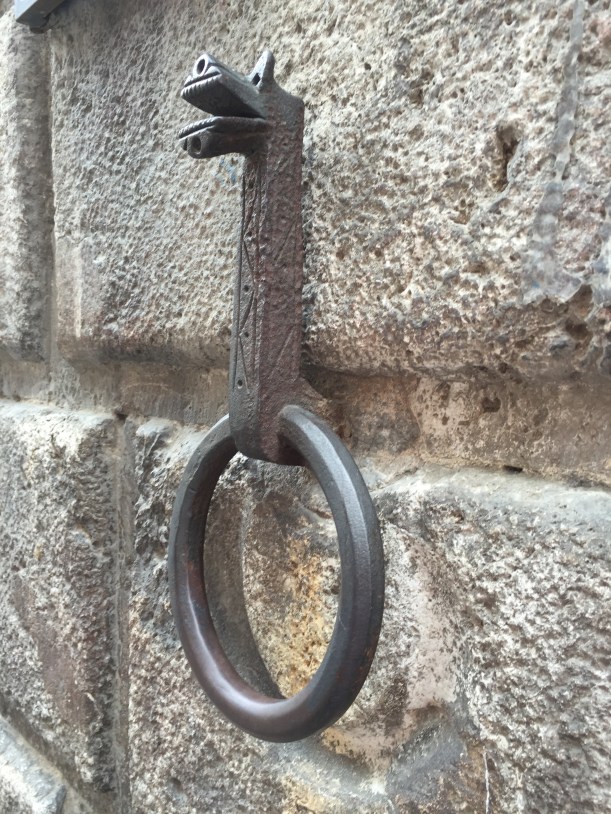
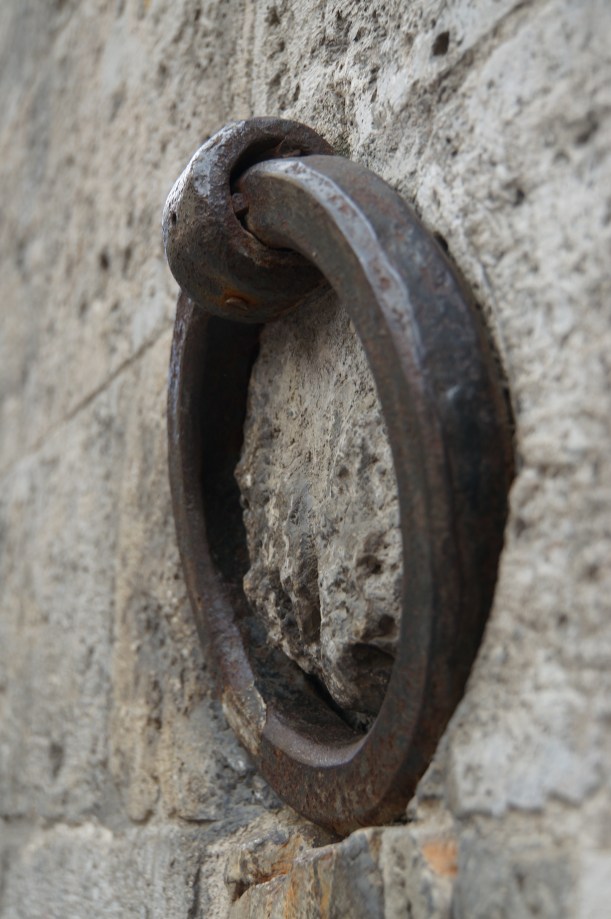
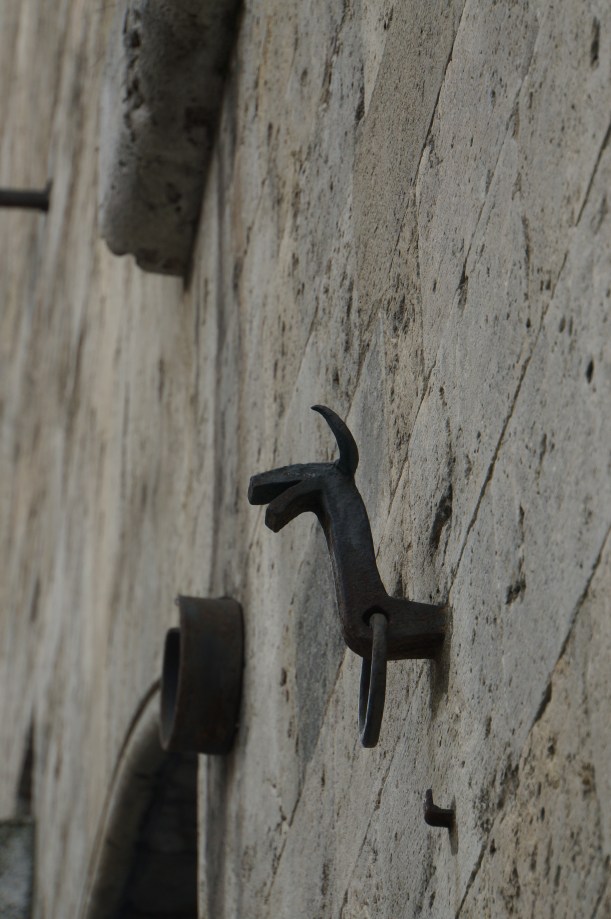
The other tidbit that we found interesting was the ironwork horse hitches that were sprinkled all over the city. Obviously owners would need to tie their horses up when they “parked” them outside their homes and businesses, but the detail and humour of the ironwork itself certainly caught the attention of me and my camera lens.

From Siena we headed off to San Gimignano. Stay tuned for more on that…






 Maps & Flip Flops